

IHANAT
Idea Hub for Arctic Nature and Technology
Co-funding: Interreg Aurora and Region Norrbotten
Duration: April 2026 - October 2026
Status: Ongoing
Coordinator: Luleå University of Technology
Project Partner: Economic Development Centre of South Ostrobothnia
Overview
IHANAT connects ecological and technological expertise to enable the practical use of AI and robotics in invasive alien species management. The project develops a usable framework for detecting and managing species such as Himalayan balsam, while integrating results from the INSPIRE and ROBODEMO projects into real-world demonstrations. It also supports SME competitiveness by fostering innovation at the intersection of technology and nature-based services, and strengthens cross-border cooperation between Sweden and Finland for sustainable biodiversity protection.
Key concept combines robotic advancements with ecological expertise to develop scalable, low-impact solutions for monitoring and managing invasive alien species. Thus, enabling public authorities and SMEs to adopt technology-driven approaches for ecosystem protection. The project strengthens cross-border cooperation between Sweden and Finland, supports innovation in eco-technologies, and contributes to biodiversity protection and ecosystem resilience, aligning with SDG 15 (Life on Land), SDG 9 (Industry, Innovation and Infrastructure), and SDG 17 (Partnerships for the Goals).
Project Partners




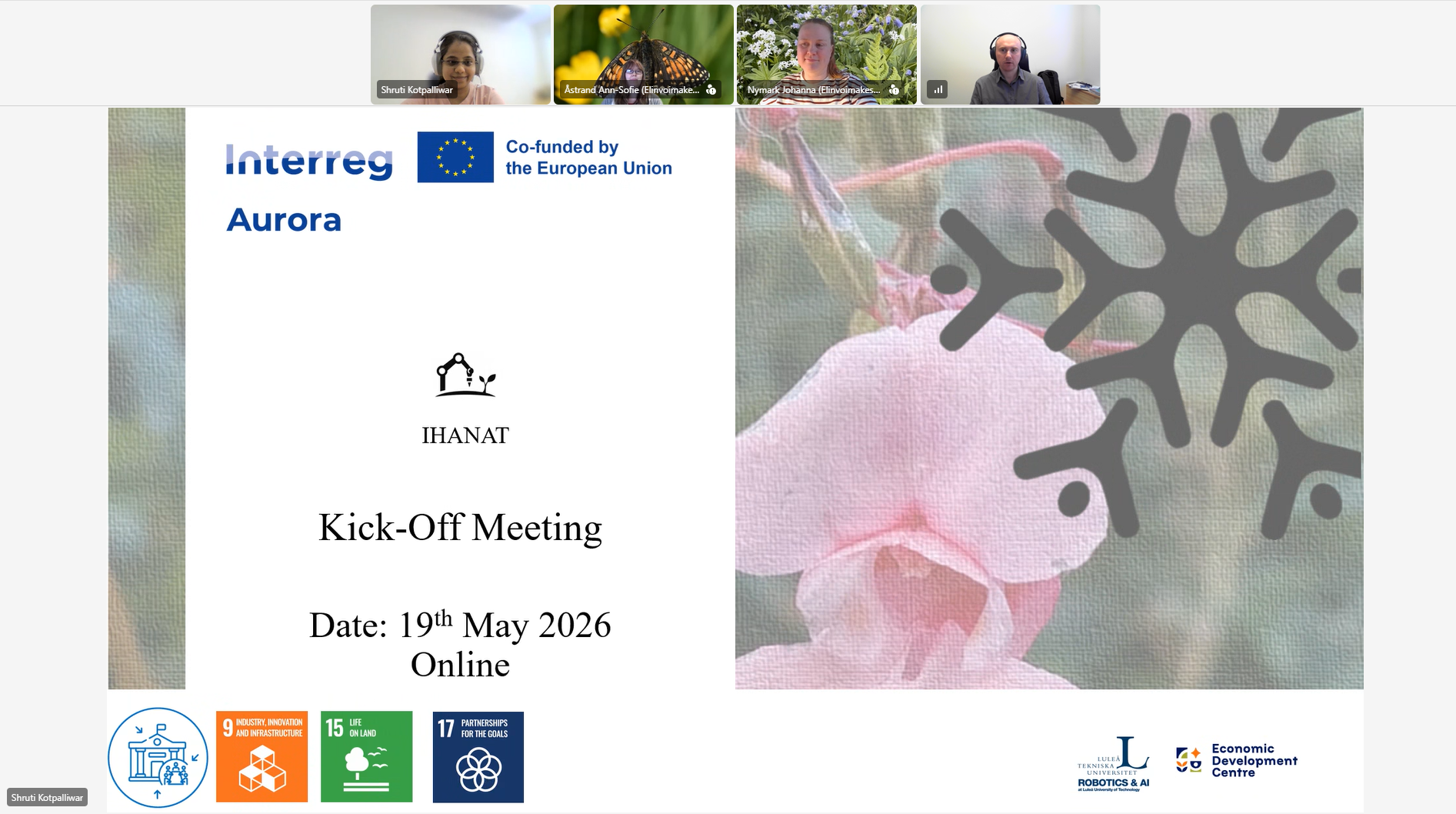
The kick-off meeting for IHANAT was conducted online in May 2026.
From left: Shruti Kotpalliwar, Ann-Sofie Åstrand, Johanna Nymark and Anton Koval.
Upcoming events
Webinar 1: Introduction to Invasive Species Management, Technology, and Opportunities
Date: 22 June 2026, Mode: Teams Online Webinar
Webinar 2: Brainstorm Innovative Solutions for Invasive Species Management
Date: 25 June 2026, Mode: Hybrid
Webinar 3: Ideas into Action: Refining Solutions
News
INSPIRE and IHANAT teams met in Vaasa to explore AI and robotics for nature protection
The INSPIRE and IHANAT project teams met in Vaasa on 23–25 June for a joint workshop and study visit. The meeting brought together expertise from the Interreg Aurora and Northern Periphery and Arctic (NPA) programmes, creating new opportunities for collaboration and knowledge exchange.
One of the main takeaways was the importance of bridging the gap between technology and nature conservation. Robotics and AI offer great potential, but they need real-world environmental challenges—such as invasive alien species management—to develop practical solutions.
The workshop also generated several promising ideas, including testing sensors for invasive species detection, using automation for targeted lupine removal, applying 3D modelling to map invasive plants, and using AI to identify raccoon dogs from wildlife camera images.
The visit highlighted how combining expertise from different disciplines can inspire innovative approaches to protecting nature.